FHA 203(k) Loan Chicago: Buy & Renovate Fixer-Uppers in 2026
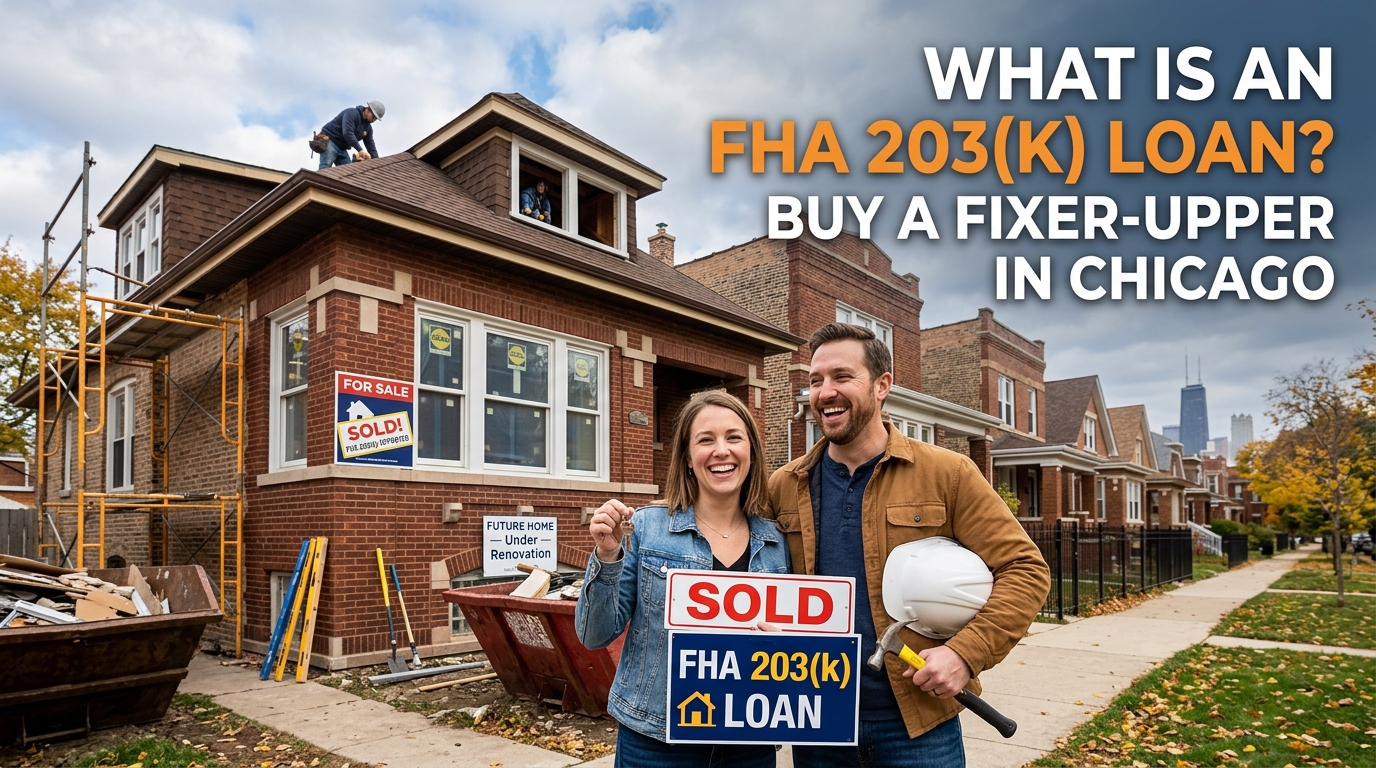
What Is an FHA 203(k) Loan? Buy a Fixer-Upper in Chicago
Finding a move-in-ready home in Chicago at an affordable price can feel like searching for a needle in a haystack. The city's beautiful older housing stock often needs repairs and updates—but what if you could purchase and renovate that perfect fixer-upper with a single mortgage? An FHA 203(k) loan makes this possible for qualified buyers. This comprehensive guide explains how FHA 203(k) renovation financing works, whether your Chicago dream fixer-upper qualifies, and how to determine if this program aligns with your home-buying goals.
Quick Answer: What Is an FHA 203(k) Loan?
An FHA 203(k) loan is a government-backed mortgage program that finances both the purchase of a property and its eligible repairs in a single loan. Eligible buyers can finance up to $75,000 in repairs (Limited 203(k)) or unlimited renovation costs for major structural work (Standard 203(k)), making it possible to buy a fixer-upper below market value and improve it with one mortgage payment instead of two separate loans.
📋 On This Page
- What Is an FHA 203(k) Loan?
- How Does an FHA 203(k) Loan Work?
- FHA 203(k) Limited vs. Standard
- What Repairs Can Be Covered?
- Can You Buy a Fixer-Upper in Chicago?
- Down Payment & Financial Requirements
- FHA 203(k) Loan Requirements
- How Much Can You Borrow?
- Benefits in Chicago
- Potential Drawbacks
- Financing Options Comparison
- Frequently Asked Questions
What Is an FHA 203(k) Loan?
An FHA 203(k) loan is a government-backed mortgage program administered by the Federal Housing Administration (FHA) that allows eligible borrowers to finance both the purchase of a property and its eligible repairs and improvements within a single mortgage. This is fundamentally different from a traditional FHA mortgage, which finances only the purchase of a move-in-ready home.
The 203(k) program was created to revitalize neighborhoods and expand homeownership opportunities by enabling buyers to purchase properties that need repairs—often at lower prices than comparable move-in-ready homes—and finance the renovation costs as part of their mortgage.
💡 Chicago Real Estate Insight
Chicago's architectural heritage means many neighborhoods are full of charming older homes built in the early 1900s. Many of these properties have solid bones but need updating—they're perfect candidates for FHA 203(k) financing. A property that might sit on the market for months when priced "as-is" could become highly desirable once renovated, and an FHA 203(k) can make that transformation possible for first-time and experienced buyers alike.
Why FHA Created the 203(k) Program
The FHA recognized a market gap: thousands of properties needed repairs, but buyers lacked the capital or financing to purchase and renovate them separately. By combining purchase and renovation financing into one loan, the FHA democratized home ownership and spurred neighborhood revitalization. For Chicago, this is particularly relevant given the city's significant inventory of vintage properties.
How It Works in Principle
Instead of:
- Buying a property with a traditional mortgage
- Waiting months to save money for repairs
- Taking out a separate home equity line or renovation loan
With an FHA 203(k), you:
- Identify a property needing repairs
- Estimate the renovation costs
- Apply for one FHA 203(k) mortgage that covers both
- Close on the property
- Complete approved renovations
- Move into your improved home
How Does an FHA 203(k) Loan Work?
Understanding the FHA 203(k) process step-by-step helps buyers prepare mentally and logistically for what to expect. The process is more involved than a traditional purchase, but it's structured to protect both you and the lender.
Find a Qualifying Property
You identify a property that meets FHA guidelines and needs eligible repairs. The property must be a single-family home, townhome, or FHA-approved condo (not co-ops). It should be structurally sound enough to be safely inspected and appraised.
Assess Renovation Needs
Get a professional home inspection to identify what repairs are needed. The inspection report becomes the basis for your renovation scope.
Obtain Contractor Estimates
Work with FHA-approved contractors to estimate the cost of repairs. For a Standard 203(k), you'll need a detailed scope of work prepared by an FHA-approved consultant.
Determine Your Program Type
Decide whether a Limited 203(k) (simpler repairs, up to $75,000) or Standard 203(k) (major structural work, no limit) fits your needs.
Apply for Financing
Work with an FHA-approved lender to submit your application. The lender will verify your credit, income, employment, and down payment capacity. The application process is similar to a traditional FHA mortgage.
Appraisal & Underwriting
An FHA appraiser evaluates the property in its current condition and projects its value after repairs. The lender underwrites the complete package—purchase price + renovation costs + your financial profile.
Loan Approval & Closing
Once approved, you close on the property. Renovation funds are typically held in an escrow account, not released all at once.
Renovations Begin
Your contractor begins work according to the approved scope. Work is typically completed in phases.
Inspections & Fund Releases
As each phase completes, an FHA consultant or inspector verifies the work. The lender releases funds (typically via two-party checks to you and the contractor) once work is approved.
Project Completion & Final Inspection
Once all work is complete and passes final inspection, remaining escrow funds are released. You now own an improved home with one mortgage payment.
⚠️ Important: Renovation Timeline
Limited 203(k) projects typically must be completed within 9 months. Standard 203(k) projects have up to 12 months. Delays in contractor availability or permit approvals can extend timelines, and delays may require lender approval. Plan conservatively and build in contingency time.
FHA 203(k) Limited vs. Standard
The FHA offers two versions of the 203(k) program, each suited to different renovation scopes. Understanding the differences helps you determine which program fits your needs.
| Feature | Limited 203(k) | Standard 203(k) |
|---|---|---|
| Maximum Renovation Cost | Up to $75,000 | No maximum limit |
| Minimum Renovation Cost | Typically $1,500+ | Minimum $5,000 |
| Project Type | Non-structural improvements; health and safety fixes | Major structural work; significant rehabilitation |
| Eligible Work Examples | Plumbing, electrical, roofing, appliances, modernization, bathrooms, kitchens | Structural repairs, foundations, room additions, major system overhauls |
| Consultant Requirement | No consultant required | Requires FHA-approved rehabilitation consultant |
| Detailed Plans Required | Not required; builder's contract sufficient | Detailed work write-ups and detailed plans required |
| Completion Timeline | Up to 9 months | Up to 12 months |
| Best For | First-time buyers; simpler renovations; faster closings | Larger renovations; structural work; neighborhood revitalization |
Limited 203(k) Program
If your renovation needs are straightforward—a new roof, updated plumbing, fresh kitchen, modernized electrical—and your total renovation costs don't exceed $75,000, the Limited 203(k) may be your best option. It's faster to process, requires less paperwork, and no formal consultant. This program appeals to many Chicago first-time buyers looking at solid older homes that just need updated systems or cosmetic improvements.
Standard 203(k) Program
If your fixer-upper needs major structural repairs, foundation work, a major room addition, or comprehensive rehabilitation, the Standard 203(k) is designed for that. The requirement for an FHA-approved consultant adds cost and time but ensures major work is properly planned and overseen. Chicago properties with foundation issues, major electrical system failures, or significant structural concerns typically fall into this category.
💡 Which Program Is Right for You?
If you're unsure, start by getting a detailed home inspection. Let the inspector tell you what the property needs. If the estimate is under $75,000 and no structural issues exist, Limited likely works. If structural problems or costs exceed $75,000, Standard is your path.
What Repairs Can an FHA 203(k) Loan Cover?
FHA 203(k) loans cover a wide range of repairs and improvements, but not every renovation is automatically eligible. The FHA has specific guidelines about what qualifies.
Eligible Repairs & Improvements
- Roofing: Full or partial roof replacement
- Plumbing: Replace water lines, update fixtures, fix leaks
- Electrical: Update wiring, upgrade panel, replace fixtures
- HVAC: Replace furnace, air conditioning, or entire systems
- Kitchen Renovation: Cabinets, counters, appliances, plumbing, electrical
- Bathroom Renovation: Fixtures, tiling, plumbing updates
- Flooring: Replace worn or damaged flooring throughout
- Structural Repairs: Foundation work, beam replacement (Standard 203(k))
- Windows & Doors: Replace old, damaged, or inefficient windows
- Insulation & Energy Efficiency: Improve insulation, weatherization
- Accessibility Improvements: Ramps, grab bars, accessibility modifications
- Pest Damage Repair: Terminate termites, repair resulting damage
- Paint & Exterior: Interior/exterior painting, siding replacement
NOT Eligible (Generally)
- Luxury upgrades or high-end finishes beyond functional need
- Swimming pools, hot tubs, or recreational amenities
- Landscaping beyond basic property improvements
- Appliances and fixtures that are luxuries (though necessary replacements are covered)
- Personal property (furniture, art, etc.)
- Land improvements like driveways or fencing (with limited exceptions)
⚠️ Important: Get FHA Approval First
Before starting any work, get written approval from your lender and FHA consultant (if required) that the repairs qualify. Doing work that doesn't meet FHA guidelines could mean the lender won't reimburse you, leaving you out-of-pocket.
Chicago-Specific Considerations
Chicago's older homes often need:
- Plumbing updates: Lead line replacement, modernization of outdated galvanized pipes
- Electrical upgrades: Knob-and-tube wiring replacement, panel upgrades for modern demand
- Foundation work: Common in Chicago's clay soil; stabilization and waterproofing qualify
- Heating system updates: Essential in Chicago winters; furnace and boiler replacement qualify
- Asbestos remediation: Common in older Chicago properties; abatement qualifies if necessary
Work with your contractor and lender to ensure your specific repairs are FHA-approved before proceeding.
Can You Buy a Fixer-Upper in Chicago With an FHA 203(k) Loan?
Yes—but with important caveats. Chicago is an excellent market for FHA 203(k) financing, given the city's abundance of older homes. However, not every Chicago fixer-upper will qualify.
Why Chicago Properties Often Qualify
Chicago's housing stock is predominantly pre-1950, with charming vintage properties throughout neighborhoods like Pilsen, Logan Square, Ukrainian Village, Bridgeport, and beyond. Many are structurally sound with solid bones but need systems updates. These properties are ideal FHA 203(k) candidates.
Property Types That Can Work
- Single-family homes: The most common FHA 203(k) property type
- Townhomes/Rowhouses: Common in Chicago; generally qualify if owner-occupied
- FHA-Approved Condos: Some Chicago condos qualify, but the building must be FHA-approved and meet specific requirements
Properties That Generally DON'T Qualify
- Severely damaged properties: If structural damage is so extensive the property can't be safely inspected and appraised in its current state, it won't qualify
- Co-ops: FHA does not finance co-operative ownership structures
- Multi-unit buildings (3+ units): Unless you're buying a 2-unit property and occupying it as your primary residence
- Properties not meeting minimum property standards: Must be safe and capable of inspection
- Certain condos: Buildings with FHA approval issues, excessive investor ownership, or HOA problems
💡 Chicago Neighborhood Considerations
FHA financing is available in all Chicago neighborhoods, but some neighborhoods have stronger resale markets than others. Before pursuing a fixer-upper, consider the neighborhood's appreciation potential, school district if relevant, job market proximity, and long-term desirability. A well-renovated fixer-upper in a stable, desirable Chicago neighborhood is an asset; the same property in a declining area may not appreciate as expected.
Historic Properties & Restrictions
Chicago has significant historic property designations. If your fixer-upper is in a historic district or is historically landmarked, restoration work may need to comply with historic preservation guidelines. This can affect what renovations are allowed and may require special permits from the City of Chicago. Discuss this with your lender and contractor early.
City of Chicago Permitting
Chicago requires permits for most renovation work. Budget time and money for:
- Building permits for structural work
- Electrical permits for electrical work
- Plumbing permits for plumbing work
- Mechanical permits for HVAC work
Permitted work must pass city inspection. This adds time to the project, but it protects your investment and ensures work meets code. Your contractor should handle permitting, and costs typically include permit fees.
What You Should Verify
⚠️ Due Diligence for Chicago Fixer-Uppers
Before committing to a fixer-upper, verify:
- Property passes FHA minimum property standards inspection
- Property can be safely inspected and appraised in current condition
- No title issues or liens exist
- HOA (if condo) approves the purchase and renovation plans
- No historic designation conflicts with your renovation plans
- Estimated renovation costs are realistic and reasonable
- You understand the Chicago permit process and timeline
FHA 203(k) Down Payment and Financial Requirements
FHA 203(k) loans follow standard FHA financial requirements, making them accessible to buyers who might not qualify for conventional financing.
Down Payment
FHA loans require a minimum down payment of 3.5% of the property's appraised value after renovations. This is one of the advantages of FHA financing—you're not required to have 20% down like conventional mortgages.
📊 Down Payment Example
Let's say you're buying a Chicago home appraised at $200,000 (as-is), with $50,000 in approved renovations. The projected value after repairs is $250,000. Your FHA 203(k) loan would require 3.5% down on $250,000, which is $8,750. This is calculated on the post-renovation value, not just the purchase price—an important distinction that can lower your required down payment compared to conventional financing.
Credit Score
FHA loans typically require a minimum credit score of 500–580, depending on your lender. Many lenders prefer 620+. If your credit is lower but you're making progress, ask your lender about loan options. FHA is more forgiving of past credit challenges than conventional lenders, especially if you can demonstrate that issues are resolved.
Debt-to-Income Ratio (DTI)
FHA allows borrowers with debt-to-income ratios up to 50% (your total monthly debt payments divided by gross monthly income). Some lenders may require lower ratios. Calculate your DTI before applying to understand your borrowing capacity.
Mortgage Insurance
FHA 203(k) loans require mortgage insurance:
- Upfront Mortgage Insurance Premium (UFMIP): 1.75% of the loan amount, typically financed into the mortgage
- Annual Mortgage Insurance Premium (MIP): Varies (0.55%–0.80% annually), divided into 12 monthly payments
The mortgage insurance protects the lender if you default. It's a cost of FHA financing, but the lower down payment requirement and accessibility often make FHA loans worthwhile despite the insurance cost.
Income Verification
You'll need to verify stable income through:
- Recent W-2s (typically 2 years)
- Recent pay stubs
- Tax returns (typically 2 years)
- Employment verification from your employer
Self-employed borrowers need 2 years of tax returns and may need to provide profit-and-loss statements. Lenders want to see stable or growing income.
Reserves
Some lenders may require you to have reserves (savings) equal to 1–2 months of mortgage payments after closing. Discuss this requirement with your lender upfront.
⚠️ Important: Current Rules and Limits
FHA rules and loan limits change annually. The information above reflects 2026 guidelines. Before applying, verify current requirements with an FHA-approved lender, as program details and limits may have changed since publication. Contact HUD.gov or an FHA-approved lender for the most current information.
FHA 203(k) Loan Requirements: A Complete Checklist
Understanding FHA requirements helps you prepare and avoid surprises. Here's what the FHA requires:
Borrower Requirements
- Legal U.S. residency (citizen or eligible noncitizen)
- Ability to document income and stable employment
- Minimum credit score of 500–580 (500–640 for Standard 203(k) with some lenders)
- Debt-to-income ratio no higher than 50% (lender-dependent)
- Valid Social Security number
- No recent bankruptcy or foreclosure (must wait specific periods)
Property Requirements
- Must be owner-occupied as primary residence (FHA 203(k) is not for investment properties)
- Must pass FHA minimum property standards (safe, sanitary, structurally sound)
- Must be located in the U.S. (not territory)
- Cannot be condemned or in disrepair beyond safe inspection capabilities
- Single-family homes, townhomes, or FHA-approved condos (no co-ops, no multi-unit 3+)
Renovation/Work Requirements
- Must use FHA-approved or licensed contractors (lender-dependent requirements)
- All work must meet FHA guidelines for eligible repairs
- Detailed work write-up required (especially Standard 203(k))
- Work must comply with local building codes and permit requirements
- Lender inspections at various stages of completion
Appraisal & Documentation
- FHA appraisal required (separate from a standard home inspection)
- As-is appraisal of property in current condition
- After-repair appraisal projection based on completed work
- Contractor estimates for all proposed work
- Work write-up/scope outlining all approved renovations
💡 Pro Tip: Know the Difference
FHA Requirements are set by the Federal Housing Administration and apply to all FHA 203(k) loans nationally. Lender Requirements are individual lender overlays—additional restrictions some lenders impose. Always ask your lender if they have any requirements beyond FHA minimum standards. Some lenders are more flexible than others.
How Much Can You Borrow With an FHA 203(k)?
The amount you can borrow depends on several interrelated factors. There's no single answer, but understanding these factors helps you calculate your potential borrowing power.
Key Factors Determining Your Loan Amount
- FHA county loan limit for your area (set annually)
- Property's appraised value after repairs (the FHA will appraise the property as-is and project its value post-renovation)
- Your down payment amount (typically 3.5% of after-repair value)
- Your debt-to-income ratio (limits the maximum loan amount based on your income)
- Your credit score and financial profile (affects approval and loan terms)
- Eligible renovation costs (only FHA-approved work is included)
- Lender requirements (some lenders have additional restrictions)
⚠️ FHA County Loan Limits
FHA sets maximum loan limits for each county. Chicago is in Cook County. Your total FHA 203(k) loan cannot exceed Cook County's FHA loan limit (which changes annually). Contact the HUD Loan Limits page or an FHA lender for the current 2026 Cook County limit. Exceeding the limit is not an option—it's a hard cap.
Simple Calculation Example
📊 Hypothetical Example (For Illustration Only)
Scenario: You're buying a Chicago home listed at $200,000 (as-is). A home inspector identifies $40,000 in repairs (roof, electrical, plumbing, kitchen update). You have $10,000 saved for a down payment.
How the Math Works (Simplified):
- As-is property value: $200,000
- Estimated renovations: $40,000
- Projected value after repairs: $240,000
- Your down payment (3.5% of $240,000): $8,400
- FHA loan amount: $240,000 − $8,400 = $231,600
- Plus upfront mortgage insurance (1.75%): ~$4,053 (financed into loan)
- Total 203(k) loan: ~$235,653
Disclaimer: This is a simplified example for illustration only. Actual loan amounts depend on:
- FHA appraiser's value determination (may differ from your estimate)
- Your debt-to-income ratio limiting max loan size based on income
- County loan limits (cannot exceed)
- Lender-specific requirements
- Actual mortgage insurance rates
- Other costs (credit report, appraisal, etc.)
Always work with an FHA-approved lender to calculate your actual borrowing capacity.
Getting a Loan Pre-Approval
The best way to know your actual borrowing power is to get pre-approved by an FHA lender. Bring documentation of your income, credit, and assets. The lender will:
- Pull your credit report
- Verify your income and employment
- Calculate your debt-to-income ratio
- Determine your maximum loan amount
- Issue a pre-approval letter
This pre-approval letter is essential when making an offer on a property, as sellers want assurance that you can actually close on the deal.
Benefits of Using an FHA 203(k) Loan in Chicago
If the FHA 203(k) sounds complex, remember why so many Chicago buyers use it: the benefits are substantial.
Lower Entry Price
Fixer-uppers often cost 20–40% less than comparable move-in-ready homes. By using FHA 203(k) financing, you can purchase a property below market value, renovate it, and build equity faster than buying an already-updated home at full price.
Single Mortgage Payment
Instead of managing a purchase mortgage plus a separate home equity line or construction loan, you have one payment. Simpler accounting, simpler budgeting.
Low Down Payment
3.5% down is significantly lower than conventional loans (typically 10–20% down required). This makes homeownership accessible to buyers who don't have substantial savings.
Renovation Financing Built In
You're not forced to live in a partially renovated home or stretched thin financially while completing repairs. The renovation financing is built into the mortgage from day one.
Standardized Process
FHA 203(k) is regulated and standardized nationally. While the process is thorough, it's predictable. You know what to expect at each stage.
Opportunity for Customization
You're not stuck with someone else's renovation choices. You can design your kitchen, select your finishes, and create the home you actually want—within FHA guidelines and your budget.
Potential for Increased Property Value
Strategic renovations can increase a property's value beyond the cost of the work. A well-executed FHA 203(k) project can yield strong equity appreciation, especially in Chicago's appreciating neighborhoods.
Chicago-Specific Advantages
Chicago has abundant fixer-upper inventory, strong neighborhood resale markets in many areas, and a solid home renovation ecosystem. An FHA 203(k) lets Chicago buyers capitalize on these local advantages.
💡 Real Estate Agent Insight
Chicago real estate professionals see FHA 203(k) as a powerful tool for buyers willing to do the work. Properties that wouldn't attract traditional buyers suddenly become opportunities. If you're patient, detail-oriented, and willing to oversee a renovation project, an FHA 203(k) can be your path to homeownership in a neighborhood you love.
Potential Drawbacks of an FHA 203(k) Loan
FHA 203(k) loans aren't right for everyone. Here are honest considerations before committing:
Complexity & Time
The process is more complex than a traditional home purchase. More paperwork, more inspections, more requirements. If you want a quick, simple purchase, FHA 203(k) isn't it.
Mortgage Insurance Costs
You're paying mortgage insurance (upfront and annual), which adds cost compared to conventional financing. Over a 30-year loan, this is significant expense.
Contractor Restrictions
You cannot hire just anyone. Contractors must meet FHA requirements (though standards vary by lender). This can limit your options and may mean paying more than you would for an unlicensed contractor willing to work under-the-table (which is a risk anyway).
Renovation Delays
If your contractor falls behind, your project timeline extends. Delays can cause you stress and may require lender approval for extensions. Living through a renovation is challenging, and delays make it worse.
Cost Overruns
If renovations cost more than estimated, where does the extra money come from? Your contractor might stop work until you pay, or you might need to ask your lender about releasing additional funds (not always guaranteed). Budget conservatively and include contingencies.
Strict FHA Guidelines
You cannot deviate from FHA-approved work. If you discover additional damage mid-project, you may not be able to fix it without lender approval and additional funds. This lack of flexibility frustrates some buyers.
Limited Property Inventory
Not every fixer-upper qualifies for FHA 203(k) financing. The more severely damaged a property is, the less likely it is to qualify. You may fall in love with a property only to discover it doesn't meet FHA standards.
Appraisal Risk
The FHA appraiser might value the after-repair property lower than your contractor estimates. If the appraisal comes in below your expectations, your loan amount could be reduced, affecting your down payment and project scope.
Not for Investment Properties
FHA 203(k) requires owner-occupancy as a primary residence. You cannot use it to purchase a rental property or investment property, limiting its applicability for real estate investors.
⚠️ Critical: Renovation Project Stress
Do not underestimate the stress of managing a renovation project while closing on a home. There will be days when you question your decision. Contractors may miss deadlines. Surprises will emerge. Make sure you're emotionally prepared for this commitment before starting an FHA 203(k) project.
FHA 203(k) vs. Other Chicago Financing Options
FHA 203(k) is one option, but not the only way to finance a fixer-upper. Here's how it compares to alternatives:
| Financing Option | Best For | Main Advantage | Main Drawback |
|---|---|---|---|
| FHA 203(k) | First-time buyers with limited down payment; moderate renovations | Low down payment (3.5%); single mortgage; accessible credit requirements | Mortgage insurance cost; complexity; strict FHA guidelines |
| Conventional Renovation Loan | Buyers with strong credit and larger down payment | Potentially lower mortgage insurance; fewer restrictions on renovations | Higher down payment required (10–20%); stricter credit/income requirements |
| Home Equity Line of Credit (HELOC) | Current homeowners with home equity; for renovation financing only | Flexible access to funds; only pay interest on what you use | Requires existing home equity; variable interest rates; not for purchase financing |
| Construction Loan + Mortgage | Severe fixer-uppers that don't qualify for 203(k); significant customization | Flexible renovation scope; no FHA restrictions | Two separate loans; higher down payment; more complex; higher costs |
| Cash Purchase | Investors with substantial capital | No financing costs; complete control; fast closing | Requires large cash reserves; ties up capital; loses mortgage tax benefits |
| Hard Money / Private Lending | Desperate situations; severe fixer-uppers; fast timelines | Fast funding; flexible property qualification | Very high interest rates (10–18%+); short terms; high fees; predatory |
The Verdict for Chicago
For most Chicago first-time and second-time buyers with limited down payment savings and decent credit, FHA 203(k) is often the best option. It balances accessibility, cost, and structure. For buyers with stronger financial profiles, conventional renovation financing might offer savings. For severe fixer-uppers that don't qualify for FHA, a construction loan might be necessary. Discuss all options with your lender.
Frequently Asked Questions About FHA 203(k) Loans
The FHA allows credit scores as low as 500, though many lenders prefer 580 or higher. If your credit is lower, some lenders still work with you if you can show compensating factors (substantial down payment, strong income, etc.). The higher your credit score, the better your loan terms will be.
Yes, if the condo building is FHA-approved. Not all Chicago condos are FHA-approved, so you'll need to verify with your lender before making an offer. Ask your real estate agent or lender to check the FHA-approved condo list for the specific building.
Limited 203(k) projects must be completed within 9 months; Standard 203(k) projects have up to 12 months. The closing process itself takes 30–45 days. So total time from finding a property to completion is typically 4–15 months, depending on project scope and contractor schedules.
Requirements vary by lender. Most lenders require contractors to be licensed and in good standing, but not necessarily on a formal FHA-approved list. Ask your lender what contractor qualifications they require. Your contractor must meet those qualifications.
It depends on your financial situation and tolerance for complexity. If you have limited down payment savings but solid income and credit, FHA 203(k) opens doors that would otherwise be closed. If you already have 20% down saved and strong credit, conventional financing might be simpler and cheaper. Work through the numbers with a lender to compare.
Cost overruns are one of the biggest challenges. Your contractor may stop work until you pay, or you may need to ask your lender for a change order or additional funds (not guaranteed). Always include a 10–20% contingency in your renovation budget to account for surprises. Do not estimate tightly and expect no overruns.
Technically yes for Limited 203(k) projects, though it's often uncomfortable. For Standard 203(k) projects with major structural work, living in the property during renovation is usually not practical and may violate FHA occupancy requirements depending on the nature of the work. Discuss this with your lender before committing.
Typical costs include: loan origination fee (0.5–1%), appraisal ($400–800), credit report ($50–100), inspection fee (included in appraisal), upfront mortgage insurance (1.75% of loan), and closing costs (2–5% of loan). Some fees are rolled into the loan; others are paid at closing. Ask your lender for a detailed Loan Estimate outlining all costs.
Yes. Once your FHA 203(k) project is complete and you own an improved home, you can refinance into a conventional loan or another FHA loan after 6–12 months (lender-dependent), potentially dropping FHA mortgage insurance and saving money. Discuss refinancing plans with your lender upfront.
If the after-repair appraisal is lower than anticipated, your loan amount may be reduced accordingly. You may need to increase your down payment or reduce your project scope. This is why getting a realistic contractor estimate upfront is critical. If the appraisal is substantially lower, you can appeal it with additional evidence, though appeals don't always succeed.
No. FHA 203(k) requires that you occupy the property as your primary residence. Real estate investors cannot use 203(k) for rental or investment properties. If you're buying to invest, you'll need conventional or other financing.
A 203(k) consultant is an FHA-approved professional who oversees the renovation process for Standard 203(k) projects. They prepare detailed work write-ups, inspect work in progress, and verify completion. Limited 203(k) projects don't require a consultant. If you're doing Standard 203(k) work, expect to pay $800–2,000 for consultant services.
Ready to Find Your Chicago Fixer-Upper?
If you're interested in exploring FHA 203(k) financing for a Chicago property, the first step is understanding your buying power. Connect with an FHA-approved lender to discuss your financial situation and get pre-approved. Then, work with a Chicago real estate professional who understands the fixer-upper market and can help you identify properties that fit your goals and budget.
Disclaimer: This article is for informational purposes. Real estate professionals are not lenders. For mortgage approval and financing details, speak with an FHA-approved lender. FHA rules and loan limits change regularly—verify current requirements before applying.
About the Author
This guide was created by a Chicago real estate content strategist with extensive experience in FHA lending, Chicago residential real estate, and home renovation financing. The article reflects current FHA guidelines as of August 2026, based on authoritative sources including HUD.gov and Federal Housing Administration resources. For the most current information on FHA 203(k) programs, loan limits, and requirements, consult an FHA-approved lender or visit HUD.gov.