


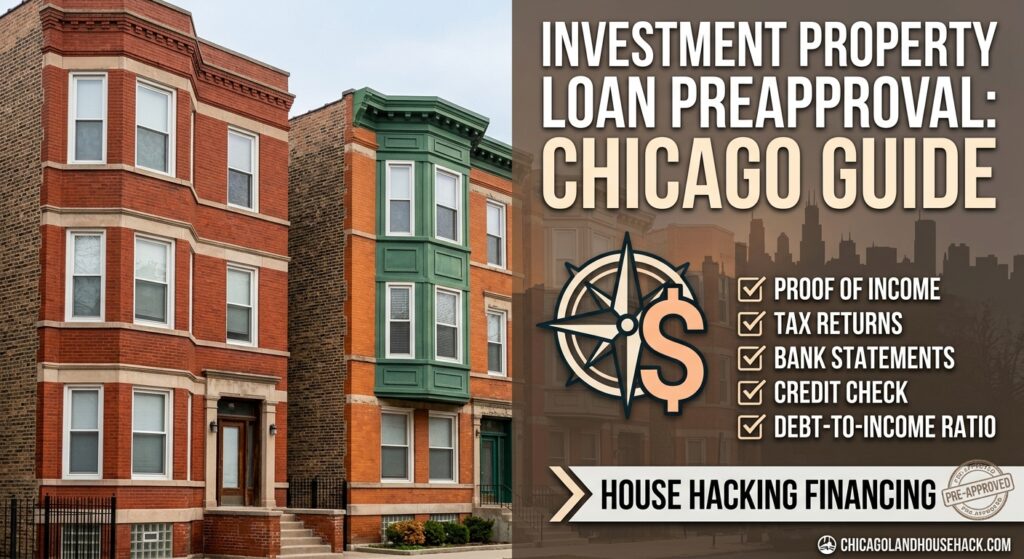
How to Get Pre-Approved for an Investment Property Loan in Chicago
A step-by-step guide to securing investment property financing fast—with lender requirements, documentation checklists, and insider tactics used by Chicago's top rental property investors.
In This Article
Getting pre-approved for an investment property loan in Chicago is the fastest path to turning offers into closed deals. Unlike traditional home purchases, investment property financing requires lenders to verify your ability to manage rental income, maintain reserves, and execute your investment strategy. Preparation and documentation make the difference between a 3-day approval and weeks of back-and-forth.
This guide walks you through the exact steps Chicago investment property investors follow to secure pre-approval, the documents lenders demand, common pitfalls to avoid, and insider tactics for navigating Chicago's competitive rental market.
Investment Property Loan Requirements: The Lender's Checklist
Before submitting your pre-approval application, lenders assess your financial profile against six core criteria:
- Your personal finances — credit score, income, debt-to-income ratio, liquid reserves
- Your investment experience and portfolio — existing rental properties, documented rental income, property management track record
1. Credit Score & Credit Profile
Minimum acceptable: 620. Competitive range: 740+. Lenders review not just your score but your credit mix, late payments, and recent inquiries. A strong investment property loan pre-approval hinges on demonstrating financial responsibility across multiple credit accounts.
2. Debt-to-Income Ratio (DTI)
Most investment property lenders cap DTI at 40–50% (compared to 43% for primary residence mortgages). Your DTI includes personal debt, existing rental property mortgages, and the new investment property loan. Chicago portfolio lenders sometimes flex to 55% if you demonstrate strong reserves.
3. Liquid Reserves
Lenders typically require 6–12 months of mortgage payments in liquid reserves (cash, money market, stocks—not retirement accounts). For a $200K rental property loan at 6% interest, that's roughly $8K–16K in accessible reserves. Strong reserves signal you can weather vacancy periods.
4. Income Verification
W-2 income, self-employment income, rental property income, and investment returns all count. Most lenders require 2 years of tax returns to verify consistency. If you're a Chicago investor building a rental portfolio, existing rental income from other properties strengthens your profile significantly.
5. Down Payment Funds
Investment property lenders verify you have 20–25% of the purchase price available at closing. For a $250K property, that's $50–62.5K in down payment reserves. Some lenders want to see these funds seasoned in your account for 60+ days.
6. Investment Experience & Property Details
First-time investors often face tighter underwriting. Lenders ask: Do you own other rentals? How long have you held them? What's your occupancy rate? For the new property, they'll request the property address, preliminary appraisal, rental comps, and your investment strategy (house hack, BRRRR, hold-for-cash-flow).
7 Steps to Get Pre-Approved for an Investment Property Loan
-
1
Gather Financial Documentation
Collect 2 years of tax returns, 2 months of recent bank statements, recent pay stubs, and if self-employed, profit & loss statements. For existing rental properties, gather 12 months of rent collection records and property tax statements. Start this process before reaching out to lenders.
-
2
Request Credit Authorization & Consent Forms
Most lenders provide a standardized credit authorization package. You'll sign authorization for the lender to pull your credit report, verify employment, and obtain bank records. This takes 15 minutes and unlocks the pre-approval process.
-
3
Complete the Loan Application
Fill out the full loan application with personal, financial, and employment details. The form asks for a property address—if you haven't selected a property yet, many lenders allow you to enter "TBD" or a target neighborhood and loan amount instead. This provides a pre-approval letter for offers before you identify the specific deal.
-
4
Submit Documentation Electronically
Use the lender's portal or email to upload all supporting documents. Most modern lenders accept secure file sharing or portals (no fax required). Upload high-quality images or PDFs of every document. Incomplete submissions delay pre-approval by 2–3 days.
-
5
Respond to Underwriter Requests
The underwriter reviews your file and may request clarifications (e.g., "Explain the $3K deposit on 6/15"), additional documents, or employment verification. Respond within 24 hours to keep momentum. This back-and-forth typically takes 1–3 days.
-
6
Receive Conditional Pre-Approval
Once the underwriter clears your file, you receive a conditional pre-approval letter. It states your approved loan amount, rate estimate, and conditions (e.g., "subject to appraisal," "subject to title review"). Most conditions disappear once you've identified the specific property.
-
7
Lock Your Rate & Finalize Terms (Once Property Identified)
When you're under contract on an investment property, the lender orders an appraisal, title search, and property inspection. Final underwriting clears these items. Rate locks typically last 30–45 days and protect you from market rate increases during the closing period.
You don't need to identify a specific investment property to start pre-approval. Many Chicago investors get pre-approved first, then shop for deals from a position of strength. Your pre-approval letter makes your offer more attractive to sellers and speeds contract-to-close timelines.
Pre-Approval vs. Pre-Qualified for Investment Property Loans
These terms are often confused, but they carry very different weight in real estate transactions:
| Factor | Pre-Qualified | Pre-Approved |
|---|---|---|
| Verification Level | Self-reported information only | Full documentation review + credit pull |
| Lender Commitment | Informal estimate, not binding | Formal commitment, subject to appraisal & title |
| Time to Receive | 15 minutes–1 hour | 3–7 business days |
| Value in Negotiations | Minimal—sellers don't trust it | High—sellers know you're serious |
| Rate Lock | No rate lock available | Rate locks 30–45 days |
| For Investment Properties | Insufficient for competitive offers | Required for serious deal pursuit |
In Chicago's competitive investment property market, pre-approval is non-negotiable. Sellers and wholesalers immediately dismiss offers without a pre-approval letter. Multiple sellers may accept bids simultaneously, and your pre-approval proves you can close.
Complete Investment Property Pre-Approval Documentation Checklist
Most lenders request these documents. Prepare them all upfront to avoid back-and-forth delays:
Pro tip: Organize documents in a folder labeled "Investment Property Pre-Approval" and share electronically via a secure portal. The cleaner your submission, the faster underwriters move.
3 Investment Property Loan Types Available in Chicago
1. Bank Investment Property Loans (Conventional)
Who offers: Chase, Citibank, MB Financial, PrivateBank & Trust (Chicago-based).
Pros: Competitive rates (5.5–7%), established underwriting, large loan amounts ($500K+), fixed or adjustable rates.
Cons: Strict DTI limits (40–45%), require 25% down, 740+ credit score preferred, 7–10 day underwriting.
Best for: Experienced investors with pristine credit and multiple existing rental properties.
2. Portfolio Lenders (Non-Traditional)
Who offers: Local Chicago mortgage brokers, non-bank lenders, private lending firms.
Pros: Flexible DTI (50–55%), 15–20% down options, pre-approval in 24–48 hours, portfolio investors welcome.
Cons: Slightly higher rates (6–8%), smaller loan maximums ($300K–$500K), less standardized processes.
Best for: First-time investors, investors with multiple recent properties, those seeking speed.
3. Hard Money / Bridge Loans (Short-Term Fix & Flip)
Who offers: Private lending companies, real estate investment firms.
Pros: 7–14 day approval, based on property value (not personal credit), up to 80% LTV, cash-out refinance options.
Cons: High interest rates (8–12%), origination fees (2–5%), short terms (6–12 months), prepayment penalties.
Best for: BRRRR investors, fix-and-flip projects, bridging cash gaps during refinances.
Comparing Loan Types for Your Investment Strategy
House Hacking a 2–4 Unit Property? Start with a bank investment loan if you have strong credit (740+), or a portfolio lender if you're under 5 years into investing.
Scaling to 5+ Rental Properties? Portfolio lenders often offer discounted rates after your first 2–3 properties close successfully.
Doing a Fix & Flip Project? Hard money or bridge loans close in weeks—use them for acquisition & renovations, then refinance to a conventional loan.
Frequently Asked Questions About Investment Property Loan Pre-Approval
Ready to Start Your Pre-Approval?
Get a tailored loan recommendation based on your investment goals and financial profile. Lori and her team at Real Estate Growth Partners have helped hundreds of Chicago investors secure pre-approval and close deals faster.
Start Your Pre-Approval ConsultationLori Wyatt
Real Estate Investment Advisor & Founder, Real Estate Growth Partners. Lori has guided Chicago investors through 50+ property acquisitions and served as an expert on rental property financing, house hacking, and BRRRR strategies.